LS Central - Shopee connects LS Central to the Shopee marketplace. The integration runs entirely inside LS Central and connects to Shopee through the Shopee Open API. Shopee is the reference implementation for the integration with marketplaces.
The first diagram shows the marketplace framework:
The marketplaces, such as Shopify, Google, and Shopee, connect to LS Central through the same Market Database Tables, which hold the configurations, items, and orders for each marketplace.
- Data flows in both directions between the marketplaces and these tables.
- ll marketplaces also share the common codeunits MarketUtils and MarketsHelper, so the same code can be reused for every marketplace.

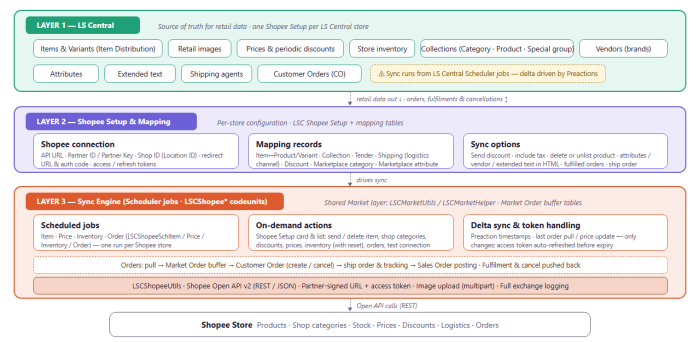
The following diagram shows how the integration is structured in three layers, which connect to the Shopee Store through Open API calls (REST).
- LS Central: The source of truth for retail data, such as items, images, prices, discounts, inventory, collections, and customer orders. There is one Shopee Setup for each store, and the synchronization runs from LS Central Scheduler jobs.
- Shopee Setup and Mapping: The per-store configuration, which holds the Shopee connection details, the mapping records, and the sync options. It drives the synchronization.
- Sync Engine: The Scheduler jobs and on-demand actions that send retail data to Shopee, and pull orders from Shopee to create customer orders. Preactions make sure that only changed data is sent, and orders, fulfilments, and cancellations are synchronized both ways.
Note: Each e-commerce platform must have its own dedicated LS Central store, to keep the data separated and avoid conflicts in product, inventory, and order information.
For example, a central web store in Shopify cannot be shared with Shopee. Create a separate store for Shopee.