In this article
Synchronizing the employee schedule with Bookings resource availability
The employee is the central record in Staff Management. Every person who needs to be scheduled on a roster, register work hours, or be paid a salary must be created as an employee. The employee record also links to the Bookings resource of the same number, so a person can be planned in Staff Management and booked as a resource for activities, reservations, or other bookable services.
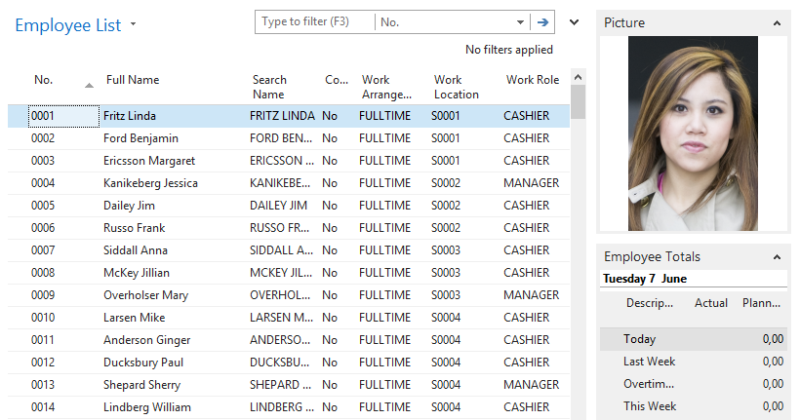
Employee fields
The following fields are found on the General FastTab of the Employee Card.
| Field | Description |
|---|---|
| No. | The identification code for the employee. It is filled in automatically from the Staff Mgt. Emp. No. Series defined on the General FastTab of the Staff Management setup. |
| First Name / Last Name | The employee's name. Used to build the Search Name automatically. |
| Job Title | A free-text description of the employee's job title. |
| Phone No., Mobile Phone No., E-Mail | Contact information for the employee. The E-Mail address is also used when the roster is sent to the employee (see the Send Roster Email action). |
| Search Name | A search reference built from the first and last name, according to the naming order set up for the company. |
| Gender | The employee's gender. |
| Status | Set to Active or Blocked. An employee must be Active before being assigned to a roster or used for clock in/out. When an employee leaves the company, set the Status to Blocked instead of deleting the record, so that the historical registrations are kept.
Note: In SaaS environments, licensing is based on the number of active employees. When you activate or block an employee, the central licensing system is checked, and activation is denied if the license limit is exceeded. Blocked employees are excluded from the license count. On the employee list, multiple employees can be activated or blocked at once using standard Business Central multi-selection and the related actions on the action bar. |
| Last Date Modified | The date the employee record was last modified. Maintained automatically. |
The following fields are found on the Workforce FastTab.
| Field | Description |
|---|---|
| Work Region | The Work regions the employee belongs to, used to filter employee availability across locations within the same region. Filled in automatically from the Work Location, but can be overridden. |
| Work Arrangement Code | Mandatory. The How to: Set Up Work Arrangement that controls how the employee's time registration is converted to salary hours. See Work Arrangement below. |
| Work Location | Mandatory. The employee's default Work locations, used as the base location for the roster schedule. Additional locations the employee can be planned in can be added with the Work Locations action, see Actions on the Employee Card. |
| Time Entry ID | Mandatory. The employee's personal ID used to clock in and out, see How to: Register Hours. Must be unique across all employees. |
| Time Entry Password | Optional password required together with the Time Entry ID when registering time. |
| Salary System ID | The ID used to reference the employee when the salary hours are exported, see Salary Hours. Must be unique across all employees. |
| Work Shift | The fixed shift the employee is automatically scheduled on, if used. See Work Shift and Shift Pattern below. |
| Work Role | Mandatory. The employee's default Work roles. See Work Role below. |
| Shift Pattern | The Shift patterns the employee is automatically scheduled according to, if used instead of a fixed Work Shift. See Work Shift and Shift Pattern below. |
| Pattern Reference Date | Only used when Shift Pattern is set. The starting reference date for the employee's own pattern cycle. If left blank, the Pattern Reference Date set on the Work locations is used instead. |
| Average Cost pr. Hour | The employee's average hourly cost, used for cost estimates when the Salary Cost setting on the General FastTab is based on the employee instead of the role. |
| Salary Type | Set to Hourly Rate, Fixed Monthly Rate, or None, depending on how the employee is paid. See Salary Hours. |
| Fixed Monthly Rate | Only used when Salary Type is Fixed Monthly Rate. |
| Fixed Monthly Work Code | Only used when Salary Type is Fixed Monthly Rate. The work code used to distribute the fixed monthly amount per day as salary cost. |
| Exclude from Salary Export | When set, the employee is skipped by the salary export process, see Salary Hours. |
In addition, the Integration FastTab can link the employee to a LS Central retail staff record, a retail user (used only for employee portal login), the standard Business Central employee record, and a contact. These fields are optional and only relevant if the corresponding integration is used.
Actions on the Employee Card
The following actions on the Employee Card open the related setup or entries for the employee:
| Action | Description |
|---|---|
| Work Roles | Assign and manage the roles the employee can be assigned to, see Work Role below. |
| Salary Settings | Set up optional employee-specific salary rates, if used. |
| Non Availability | Register vacation and other unavailability for the employee. |
| Work Locations | Set the additional work locations, besides the default Work Location, that the employee can be planned in. |
| Extra Work Codes | Set up additional fixed charges to be added to the employee's salary registration. |
| Images | Assign a picture of the employee. |
| Send Roster Email | Send the employee's current roster plan by e-mail. |
| Salary Entries, Roster Entries, Roster View, Time Registration, Work History, Absence History | Review the employee's related entries and history. |
| Card | Open the standard Business Central employee card, if the employee is linked to one through the Employee No. field on the Integration FastTab. |
Work Shift and Shift Pattern
The Work Shift and Shift Pattern fields control whether, and how, the employee is scheduled automatically when a new roster is created for the employee's work location. Only one of the two should be set on the employee; use Work Shift for a fixed shift, or Shift Pattern for a rotating pattern, but not both.
- Work Shift: Set this field if the employee always works the same Work shifts, for example a fixed day shift. Every applicable day of the week, the employee is automatically scheduled on that shift, using the hours defined for the employee's Work Role on the Work Shift card (or the shift's general hours, if no role-specific hours are defined).
- Shift Pattern: Set this field if the employee rotates through a Shift patterns, for example a "day-day-night-off-off-day-night" cycle. When a new roster is created, the employee is scheduled according to the pattern lines for the current position in the cycle. The position is calculated from the Pattern Reference Date, either the one entered on the employee, or, if blank, the one set up on the Work locations.
If neither field is set, the employee has no default schedule and must be assigned manually for every roster period, for example using the Assign to work option described in To assign an employee to work.
Note: These fields only affect what happens automatically when a new roster is created for the employee's work location. Once the roster has been created, the employee's individual entries in the roster can still be changed manually, regardless of how they were originally scheduled.
Work Role
The Work Role field on the employee is the employee's default role, used, for example, as the role suggested when the employee is assigned to work without a specific role being chosen. An employee is not limited to a single role: click the Work Roles action on the Employee Card to open the list of all Work roles the employee is qualified for. For each role assigned to the employee, you can additionally specify:
- Skill Level: A numeric skill rating for the employee in that role. This value is used when the roster's Totals setting is set to show Skill Levels, so the roster can show, per role and shift, the combined skill level of the employees currently scheduled.
- Qualifications: A free reference to the employee's qualification for the role.
- Work Arrangement Code: An optional work arrangement that overrides the employee's own Work Arrangement Code whenever the employee is scheduled in that specific role. Leave blank to use the employee's default work arrangement.
The work role is also the basis for the Location Role Budgets, which define how many employees are needed per role and shift, and it determines the short code used to quickly assign an employee to a role and shift in the roster.
Note: If you remove a role from the employee that is currently set as the employee's default Work Role, you are asked to confirm the removal, and the default is automatically switched to another assigned role, if one exists.
Work Arrangement
The Work Arrangement Code is mandatory and is the core setting that controls how the employee's time registration is converted into salary hours. It determines, among other things:
- Whether the employee is paid according to a fixed Scheduled plan, a Fixed monthly amount, or a Flexible arrangement that allows clock in/out outside the scheduled hours.
- How early or late arrivals and departures are rounded (the minute allowances).
- The optimal (recommended) number of work hours for the period, and the maximum hour limits per day, week, and month.
- How breaks are handled, and whether a threshold, for example a monthly overtime limit, automatically switches the employee to a different work code once reached.
Every employee must be assigned to a work arrangement; the full field reference for setting one up is described in How to: Set Up Work Arrangement. As described above, a specific work role assigned to the employee can also have its own work arrangement, which is then used instead of the employee's default whenever the employee works in that role.
Synchronizing the employee schedule with Bookings resource availability
If the employee also exists as a human resource in Bookings for LS Central (that is, an Resources with the same No. as the employee, belonging to a resource group of type Human), a set of background integrations keep the two records aligned:
- Whenever the employee's name, gender, mobile phone number, or e-mail address is changed, the same values are copied to the resource's Description, Gender, Phone No., and E-Mail fields.
- Whenever the employee's Status is changed, the resource Status is updated as well: an Active employee sets the resource to Active; a Blocked employee sets the resource to Inactive, provided the resource has no existing reservations that would prevent this.
How the employee's roster schedule is used to determine the resource's availability for bookings depends on the Capacity Based On setting of the resource (or its resource group):
- Staff Management Schedule: The resource's availability is checked directly against the employee's confirmed roster schedule at the moment it is needed, for example when a reservation is being made. No separate availability data is stored; the roster schedule is always the single source of truth.
- Resource Schedule: Whenever a roster schedule entry for the employee is confirmed, changed, or removed, the system automatically rebuilds the resource's day-by-day availability and unavailability entries (visible on the Resources card) for that day, based on the employee's confirmed schedule. Only entries with a Schedule Status of Confirmed are used; unconfirmed roster changes are not reflected in the resource's availability until the roster is confirmed. Any Work shifts defined for the employee's work shift and role are added as unavailability entries for the corresponding break times.
Note: Only use Resource Schedule for human resources that should follow Staff Management scheduling. If a human resource is not managed through Staff Management, its availability schedule can instead be maintained directly on the resource card.
In addition, when a resource does not have a Fixed Location of its own, the employee's Work Location (and any additional work locations assigned through the Work Locations action) determines which activity locations the resource is considered available for, so that human resources are only offered for booking at the locations where they actually work.
See also
How to: Set Up Work Arrangement